

If you’re new to search engine optimization, all the jargon can feel overwhelming. What’s a meta description? Why do backlinks matter? And what even is a canonical tag?
That’s why I created this beginner-friendly glossary: to give you a solid starting point for your SEO learning journey.
Download the free SEO essential terms glossary as a PDF
You can download the full, formatted version of this glossary here:
👉 Download Essential SEO Terms Glossary (PDF)
Or keep reading the full list below:
Essential SEO Terms to Know for Beginners
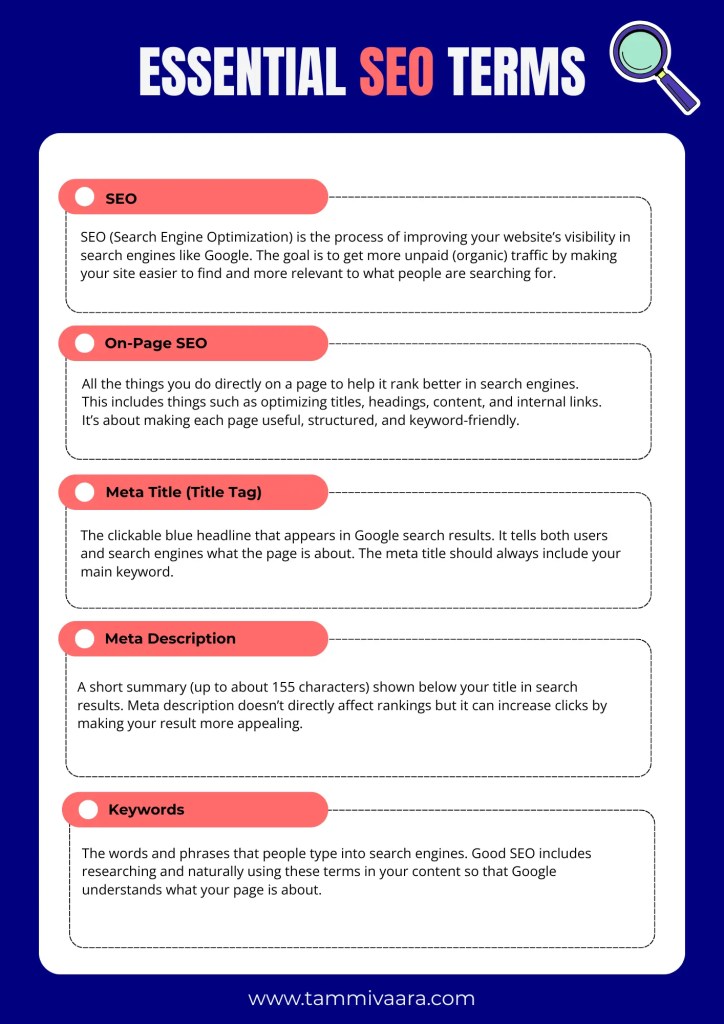
SEO (Search Engine Optimization) =
The process of improving your website’s visibility in search engines like Google. The goal is to get more unpaid (organic) traffic by making your site easier to find and more relevant to what people are searching for.
On-Page SEO =
All the things you do directly on a page to help it rank better — such as optimizing titles, headings, content, and internal links. It’s about making each page useful, structured, and keyword-friendly.
Meta Title (Title Tag) =
The clickable blue headline that appears in Google search results. It tells both users and search engines what the page is about and should include your main keyword.
Meta Description =
A short summary (up to about 155 characters) shown below your title in search results. While it doesn’t directly affect rankings, it can increase clicks by making your result more appealing.
Keywords =
The words and phrases that people type into search engines. Good SEO includes researching and naturally using these terms in your content so that Google understands what your page is about.
Keyword Stuffing =
Overloading your content with keywords in an unnatural way. This used to work in the early days of SEO but now harms your rankings and makes content hard to read.
Alt Text (Alternative Text) =
Text that describes an image. It helps search engines “see” what your image is about and improves accessibility for users who rely on screen readers.
Internal Linking =
Linking to other relevant pages within your own website. This helps users navigate and shows search engines how your content is structured and connected.
Backlinks =
Links from other websites that point to yours. These act like “votes of trust” and are one of the strongest signals Google uses to rank content.
Domain Authority (DA) =
A score (0–100) that estimates how strong and trustworthy your domain is based on its backlink profile and age. It’s not a Google ranking factor but is used as a benchmark by many SEO tools.
SERP (Search Engine Results Page) =
The page of results that appears when you search something in Google. Includes organic results, ads, featured snippets, and other elements like maps or shopping listings.
Mobile-First Indexing =
Google ranks your site based on how well it works on mobile devices. If your desktop version is perfect but your mobile site is poor, your rankings can suffer.
Page Speed =
How quickly your page loads. A slow site frustrates users and can lead to lower rankings. Compress images, limit scripts, and choose fast hosting to improve speed.
Sitemap =
A file (usually sitemap.xml) that lists all the important pages on your website. It helps search engines discover and index your content more efficiently.
Robots.txt =
A file that tells search engines which pages or files they’re allowed to crawl. Useful for keeping admin areas or duplicate content out of search results.
Anchor Text =
The visible, clickable text in a hyperlink. Search engines use it to understand the content of the linked page. For example, writing “read more about SEO best practices” is better than just saying “click here.”
Canonical Tag =
A piece of HTML code that tells search engines which version of a page is the “main” one if you have similar or duplicate content. It helps prevent SEO problems caused by duplicate pages (like product filters or tracking parameters).
Need help with rankings in Finland? I offer professional SEO in Finland for reasonable prices.


Leave a Reply